 Characters
A guide to the hanzi writing system for complete beginners
The standard thing people say about Chinese characters is that there are tens of thousands of them and you need to learn two thousand to be literate. This is technically accurate and almost entirely unhelpful as a way to start. It's a bit like telling someone who's learning to drive that there are several hundred thousand kilometres of road in the Netherlands.
What matters is that the writing system has structure, and once you start to see that structure, the characters stop looking like arbitrary drawings and start looking like what they actually are: combinations of recognisable components. That shift usually happens somewhere between week three and week eight of a beginner course, and when it does, retention improves noticeably.
What hanzi actually are
Chinese characters are not an alphabet. Each character represents a syllable, which usually corresponds to a morpheme — the smallest unit of meaning. Some characters are complete words on their own; many combine with other characters to form compound words. The character for "electricity" (dian, written 电) on its own means electricity or electrical. Combined with the character for "brain" (nao, written 脑), it becomes computer: diannao, 电脑, literally "electric brain."
This compositional logic runs through the whole vocabulary once you're a few months in. Words for new technology often use older characters in new combinations: mobile phone is "hand machine" (shoji, 手机), television is "electric vision" (dianshi, 电视). Knowing a moderate number of high-frequency characters gives you a head start on many compound words you haven't explicitly learned.
Radicals: the building blocks
Characters are built from smaller components, of which a sub-set are classified as radicals. There are around 200 common radicals. Some of them are characters in their own right — water (水), fire (火), hand (手), mouth (口) — and when they appear as components in other characters, they often carry a hint of meaning.
The character for "river" (he, 河) contains the water radical on the left. The character for "burn" (shao, 烧) contains the fire radical. The character for "language" or "talk" (hua, 话) contains the speech radical (讠), a simplified version of the character for speech (言). None of this is a perfect system — there are plenty of characters where the radical is just a historical relic — but for beginners, it provides enough hooks to make learning feel less random.
Stroke order
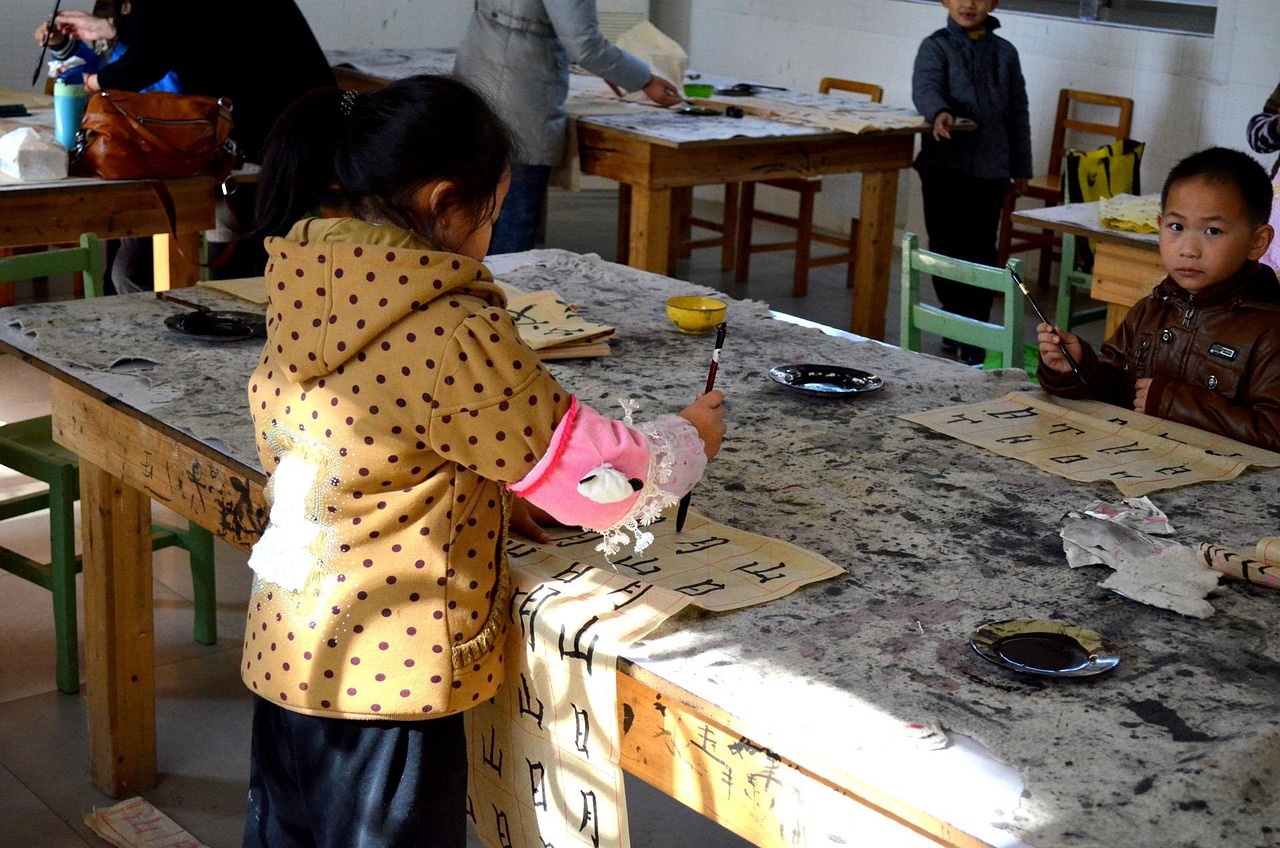
Characters are written with a specific stroke order that's been standardised. This matters less for typing (which is what most learners will do most of the time) and more for handwriting, where consistent stroke order results in faster, more natural-looking writing. It also matters for using handwriting input on a phone, which works by recognising strokes in sequence.
The general rules are predictable enough that you only need to memorise a few: top before bottom, left before right, horizontal strokes before intersecting vertical strokes. There are exceptions, and learning specific characters in class is the easiest way to absorb the pattern rather than studying the rules in the abstract.
Simplified versus traditional
Simplified characters were introduced in mainland China in the 1950s and 60s to improve literacy. Traditional characters are still used in Taiwan, Hong Kong, and much of the Chinese diaspora. The differences range from minor to substantial — some traditional characters look almost the same as simplified, others are dramatically more complex.
For learners studying Mandarin in a European context with business or mainland China in mind, simplified is the practical choice. That's what we teach in our courses. If your interest is specifically in Taiwan or Hong Kong contexts, it's worth discussing this when you start.
On flashcard systems
Spaced repetition flashcard apps are genuinely useful for character learning, and several of them work well. The problem is that apps are easier to open than to close, and a lot of people spend more time doing flashcard reviews than actually using the characters in context. The cards help consolidate what you already half-know; they're less good at teaching you a character from scratch. Class time, writing practice, and actual reading are what build the initial recognition.
Related reading
Why tones trip up Dutch speakers — Online versus in-person Chinese lessons